

Renovating your home is a complex legal and financial operation. However, most homeowners treat the process like a simple retail transaction, while professional builders treat it like a serious liability management project. Consequently, if you want to protect your investment and ensure a stress-free renovation, you must act as your own compliance auditor. Therefore, we have designed this Homeowner’s Compliance Audit to help you maintain complete control over your project lifecycle.
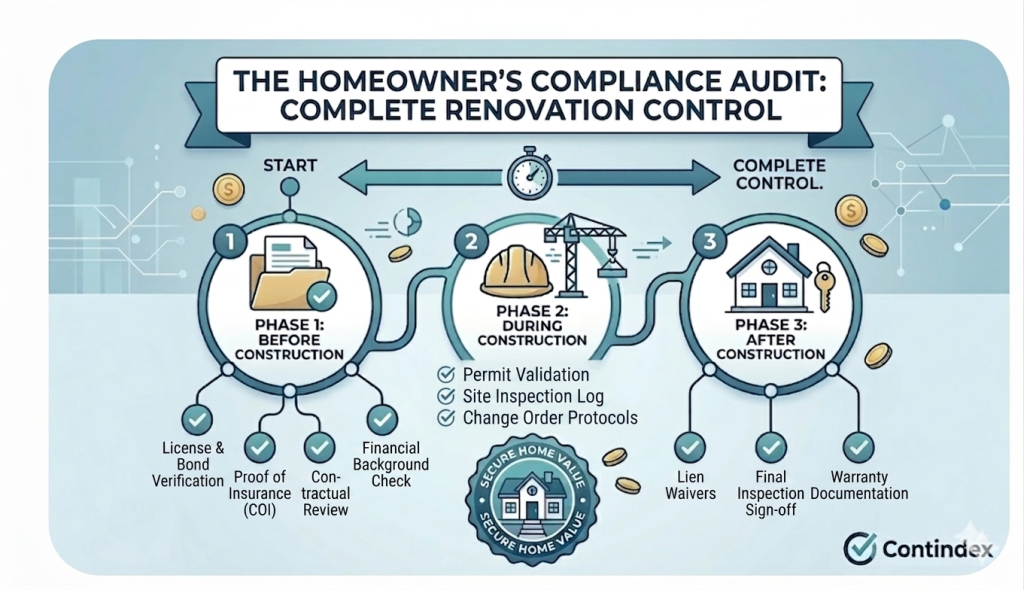
Phase 1: Performing Your Homeowner’s Compliance Audit Before Construction
Compliance begins long before the first hammer swings. Indeed, if you fail to perform due diligence here, you essentially inherit all the contractor’s legal and financial risks.
- License & Bond Verification: Never take a contractor’s word for it. Instead, you must verify your contractor’s license through official state channels to ensure they are legally authorized to operate in Washington.
- Proof of Insurance: Additionally, you must require a Certificate of Insurance (COI) that names you as the certificate holder. This protects you against accidental property damage.
- Contractual Review: First, does your agreement include a clear, itemized scope of work? Avoid vague promises at all costs. (Read more in our Smart Hiring Guide for Homeowners).
- Financial Background Check: Before signing, you should ensure the company is financially stable to avoid project abandonment. (Learn the risks in our Contractor Financial Stability Report).
Phase 2: Maintaining the Homeowner’s Compliance Audit During Construction
“Out of sight, out of mind” is precisely how construction projects go over budget and off-code. Therefore, you need constant, documented oversight to keep your home safe.
- Permit Validation: A permit is a legal contract with the city. In fact, if work is progressing without one, you are the one personally liable for stop-work orders and fines. (See our guide on When You Really Need a Building Permit).
- Site Inspection Log: You should document progress weekly. Furthermore, ask yourself if the actual installation matches the architectural plans approved at the start.
- Change Order Protocols: Never approve work with a verbal “yes.” Rather than informal agreements, every single deviation must be documented in writing. (Learn the legal requirements in our Managing Change Orders Effectively).
Phase 3: Completing the Homeowner’s Compliance Audit After Construction
Many people think the project is finished when the paint dries. Ultimately, the project is only truly finished when the legal risks are fully discharged and the site is clear.
- Lien Waivers: This is the most critical step of the entire audit. Specifically, if you pay your contractor but they fail to pay their subcontractors, you could end up with a lien on your home. (Understand how to protect your title in our Guide on Construction Liens in Washington).
- Final Inspection Sign-off: Also, ensure the local building department has officially closed the permit in their system.
- Warranty Documentation: Finally, collect all manufacturer warranties for new appliances or roofing materials. (See our Homeowner’s Post-Project Maintenance Checklist).
Why This Audit Matters
By following this methodology, you move from being a passive consumer to an active owner. You aren’t just building a room; instead, you are securing your home’s value and legal standing for years to come. Start your audit today and take full control of your renovation project.