

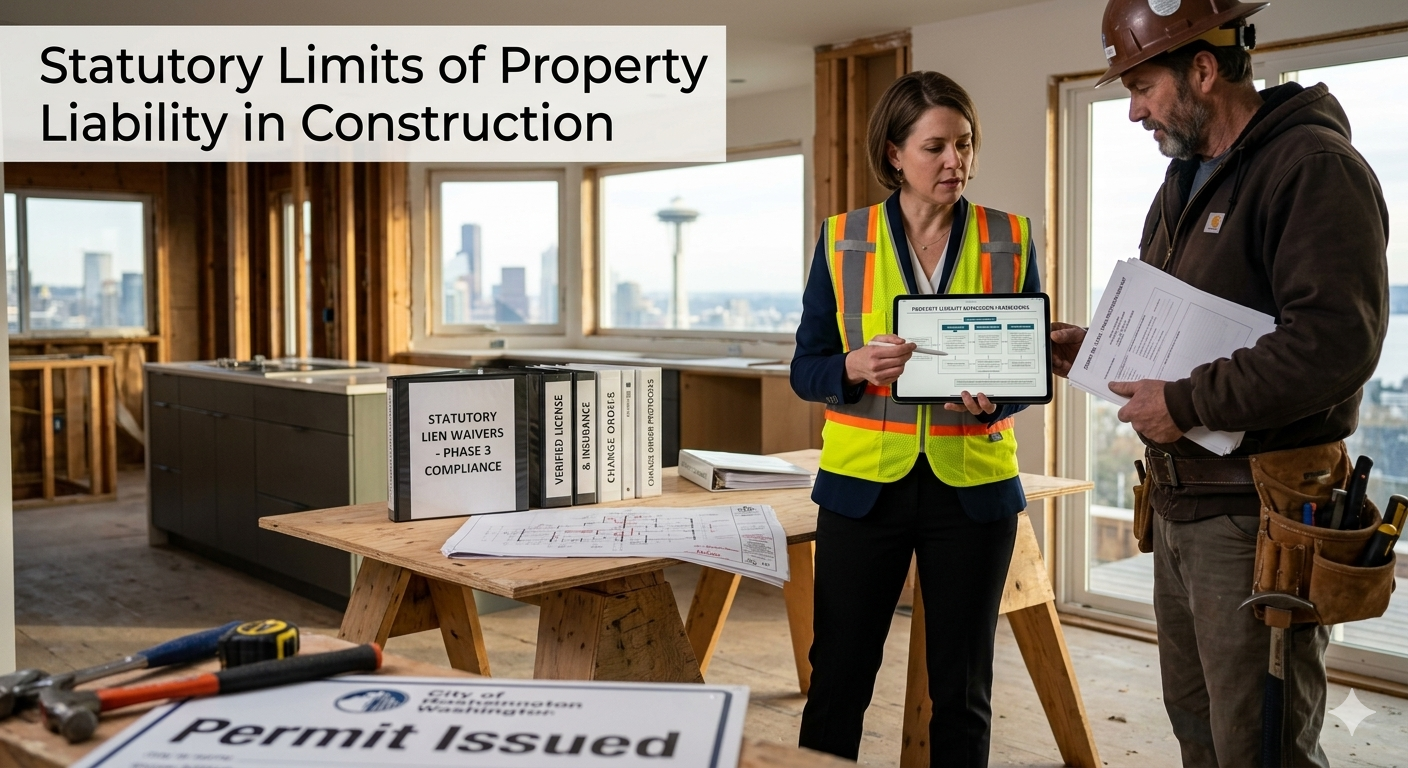
Renovating your home involves complex legal operations. Furthermore, professional builders treat construction as a serious liability management project. However, many homeowners treat it as a simple retail transaction. Consequently, if you ignore documentation, you expose yourself to unnecessary risk. Therefore, understanding the statutory limits of property liability helps you protect your investment effectively.
Understanding the Statutory Limits of Property Liability
Construction risk centers on premises liability. In fact, the legal landscape shifts the moment you invite a contractor onto your property. For instance, if you provide informal directions, the court may classify you as a prime contractor. As a result, this classification triggers significant exposures that standard insurance policies often exclude.
(Read more in our Construction Liens in Washington: How to Protect Your Property Title).
Managing Statutory Limits of Property Liability in Contracts
A contract serves as the primary tool for transferring liability. Yet, many residential agreements provide weak protection. Specifically, a failure to specify the “scope of work” creates a legal gray area. Additionally, when disputes arise, courts examine your contract to determine who bears the burden of compliance. Thus, mastering these statutory limits is essential for your protection.
- The Scope Gap: Vague language regarding materials often causes code violations. Ultimately, as the owner, you bear the responsibility for compliance with municipal standards. (See our guide on Plumbing Permits and Construction Liens: How Unauthorized Pipe Work Can Risk Your Washington Home Title).
- The Financial Gap: Moreover, if you fail to verify your contractor’s fiscal solvency, you risk liability for their unpaid bills. (Read more in our The Cost of Incomplete Data: Why Using Unverified Contractors Leads to Hidden Fees).
Ensuring Due Diligence During Construction
Under Washington law, you have a duty to perform due diligence. Indeed, courts rarely accept “ignorance of the law” as a defense. Therefore, you must use official state data as your shield against liability.
- Verify your contractor’s license through official state channels. This step remains a baseline for your protection.
- Documentation provides Evidence: Finally, treat every change order as a legal amendment. (Learn how to formalize these in our How to Read a Construction Estimate Without Getting Scammed: A Washington State Strategic Guide).
Addressing Statutory Limits of Property Liability After Construction
The project does not end when the work ceases. In reality, liability often lingers until you close the permit officially and the lien period expires. Furthermore, failing to secure warranty documentation leaves your property open to claims. Consequently, respecting these legal boundaries ensures your property remains protected. (Consult our Winter-Ready Washington: The Ultimate Home Maintenance Checklist to Avoid Costly Repairs).
Become an Active Owner
In summary, by following this methodology, you transition from a passive consumer to an active owner. Start your compliance review today and take full control of your legal standing.
Disclaimer: This article provides information only. Consult with a licensed attorney in Washington for legal counsel.