

Initially, most homeowners focus on the design phase. However, the true value of your project lies in the home improvement documentation you leave behind. If you want to protect your property title and avoid legal headaches, you must establish a rigorous audit trail. Therefore, this guide defines the essential records you must archive to safeguard your asset.
Why professional home improvement documentation matters
Many owners assume that a paid invoice serves as a complete record. In reality, a comprehensive audit trail requires far more detail. By archiving specific project files, you prove that your work meets legal standards. Thus, you eliminate ambiguity during future home inspections or sales. Furthermore, this strategy prevents construction liens from clouding your title.
Organizing your home improvement documentation
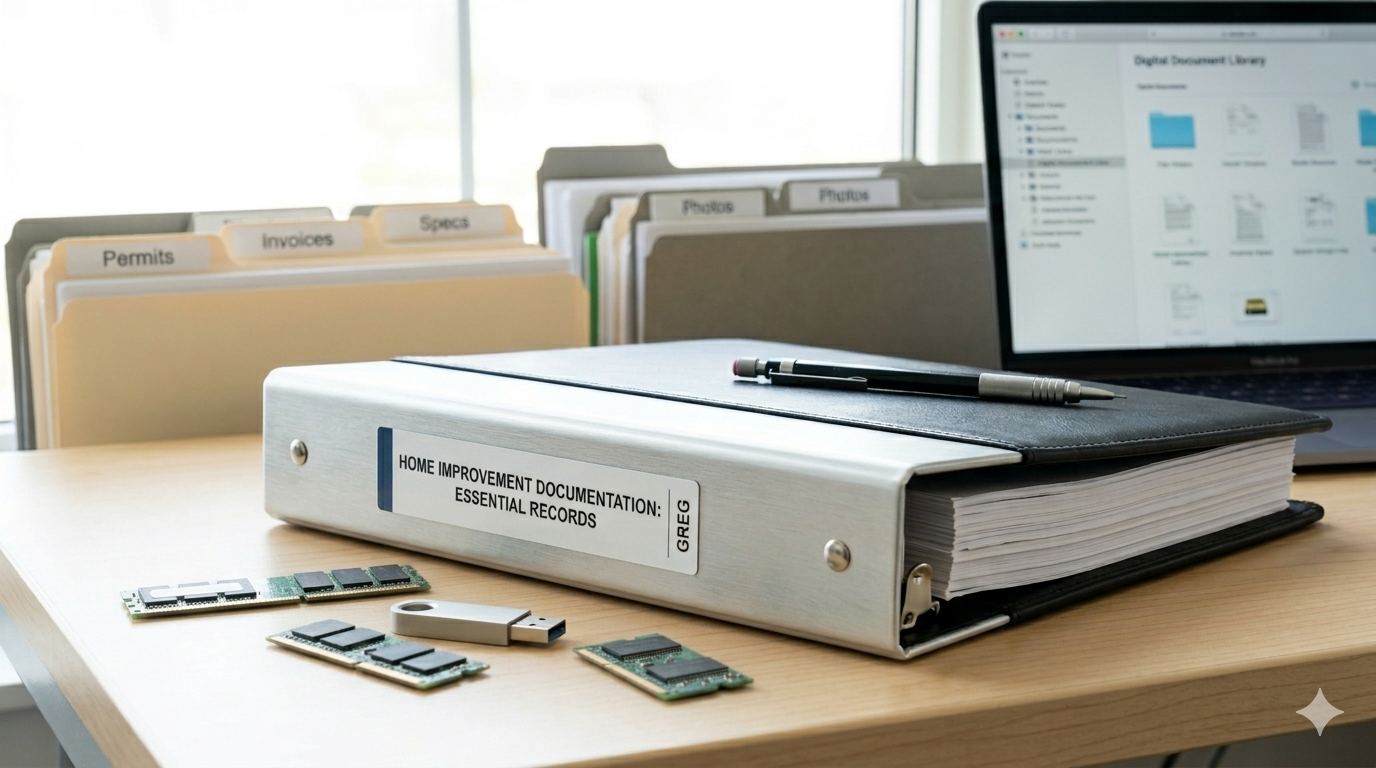
To maintain total control over your investment, you should organize your files into four distinct categories. Each category serves as a critical pillar in your property’s lifecycle.
1. Permit and inspection archive logs
Before you start any work, you must obtain local permits. You can verify your local building requirements through USA.gov to ensure full regulatory compliance. After each phase, you must archive the inspector’s sign-off. Consequently, you possess undeniable proof that your project complies with municipal building codes.
2. Material specification and documentation details
Specifically, you must track every product brand and model installed in your home. If a fixture fails, you need this data for warranty claims. Moreover, you should store digital copies of these specifications in a centralized library.
Need expert help for your specific project?Search our directory of verified professionalsto ensure your records are handled by licensed specialists.
3. Payment and lien waiver audit trail
Indeed, financial clarity remains the most important aspect of your audit. Whenever you pay a contractor, you must obtain a signed lien waiver. In addition, you must keep copies of all cancelled checks or wire confirmations to protect your home from third-party claims.
4. Photographic evidence for your audit trail
Finally, you must create a visual timeline of the transformation. While structural changes are invisible behind walls, photos document the craftsmanship. Consequently, this photographic log provides essential context for future appraisers.
Applying your home improvement documentation to your roadmap
Managing these files represents Phase 3 of the The Contindex Project Roadmap: A 4-Phase Lifecycle. Unless you maintain this trail, you effectively lose control over your property’s narrative. However, if you follow this protocol, you turn a chaotic construction site into a secure financial asset.