

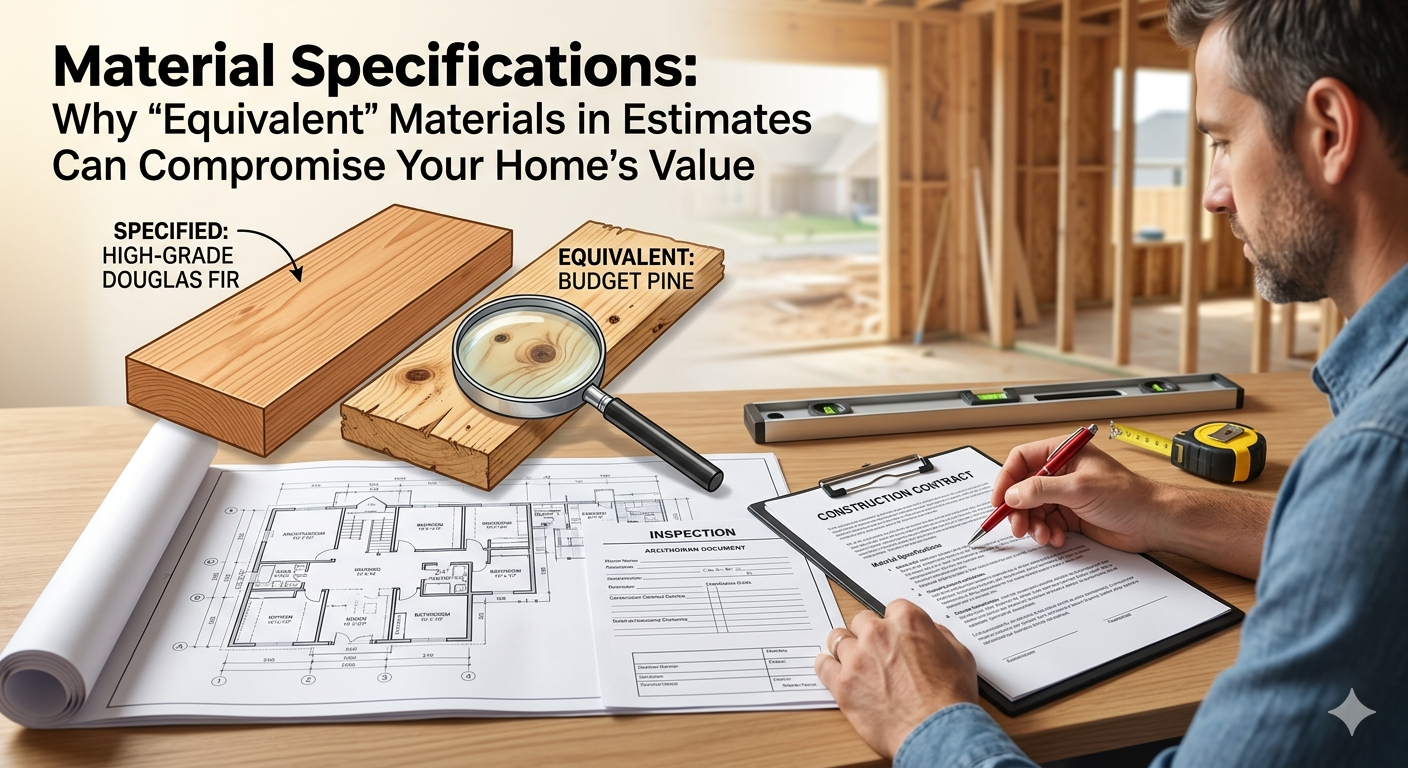
When reviewing a construction estimate, you might see the phrase “or equivalent.” However, this vague terminology is a hidden trap. To preserve your property’s integrity, you must demand exact material specifications in every contract. Failing to do so can lead to long-term structural issues and a decline in market value.
Understanding Material Specifications in Estimates
Why does the precise brand or grade of a material matter? In fact, construction is a sum of its parts. If a contractor swaps high-grade materials for “equivalents,” the performance gap often manifests as premature wear, voided warranties, or lower appraisal values. To learn how professionals evaluate this, refer to our Guide on Construction Estimates.
The Risks of Vague Material Specifications
To safeguard your investment, you must treat your project as a technical audit. Consequently, ambiguity in your contract is your greatest enemy. For residents in Washington, it is vital to ensure that all material choices comply with the Washington State Building Code, which sets the baseline for safety and quality.
Evaluating Material Specifications for Durability
Not all “equivalents” are created equal. Indeed, a lower-cost alternative may lack the necessary testing certifications. You must verify that every item in your material specifications aligns with local building codes and your long-term goals.
The Impact on Resale Value
Appraisers and savvy buyers look for premium finishes. If your material specifications were compromised during the build, your home’s resale potential diminishes. Moreover, the cost savings on the front end are often eclipsed by expensive repairs on the back end. You can verify how these upgrades influence Appraisal Values through industry-standard metrics.
Mastering Your Project Documentation
Indeed, you are the custodian of your home’s value. Therefore, keep a detailed log of all approved materials. If a contractor suggests a change, require a written justification that proves the new item meets or exceeds your original material specifications.
Protecting Your Asset Through Standardization
The project doesn’t end when the contractor leaves. Furthermore, by enforcing strict standards, you ensure that every dollar spent directly contributes to the structural and aesthetic longevity of your property.
Why Standards Matter
In summary, by rejecting vague estimates, you transition from a passive client to a strategic owner. Start auditing your construction documents today to ensure your project’s success.
Disclaimer: This guide provides information only. Always consult with a licensed contractor or building inspector regarding structural specifications.