

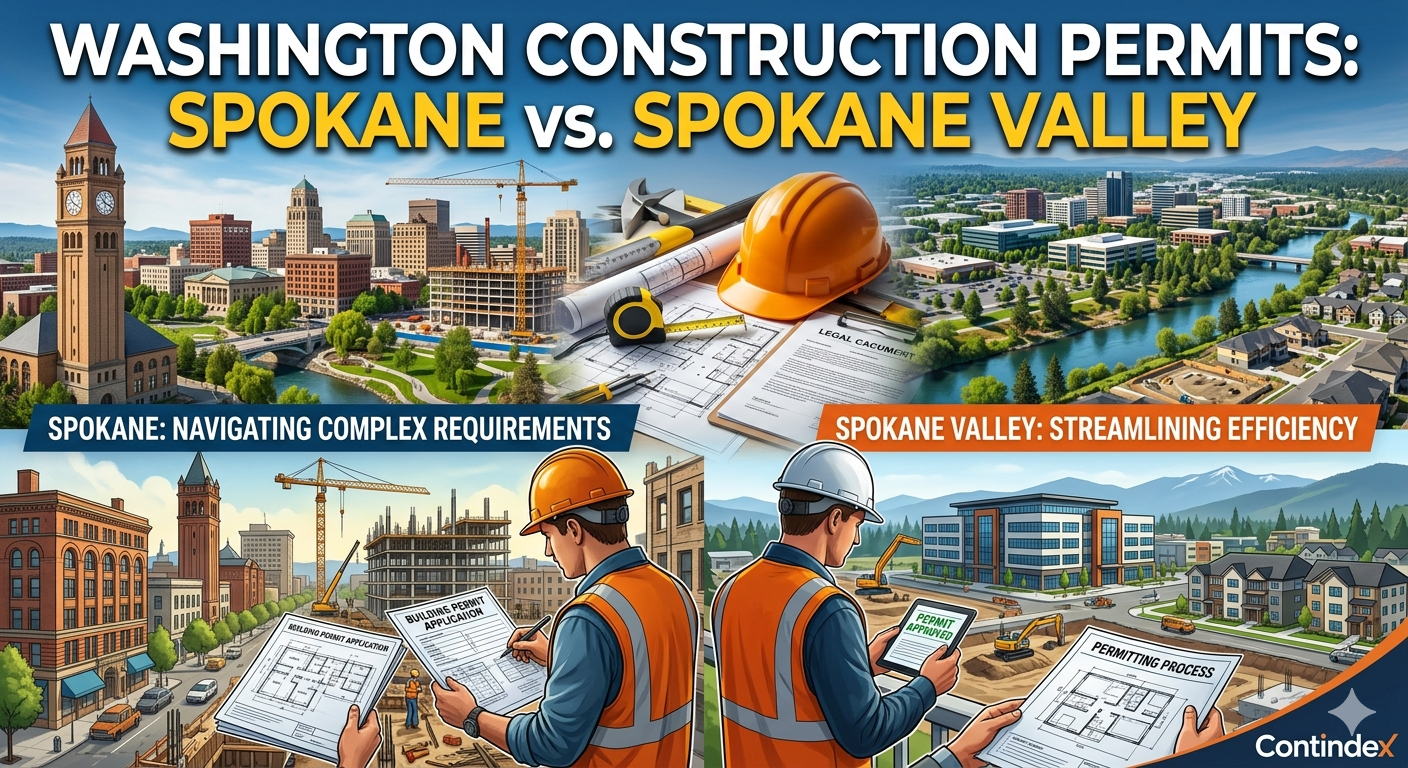
When you start a residential renovation, understanding Washington construction permits is your first step toward project success. The boundary between Spokane and Spokane Valley creates two different bureaucratic paths. Many homeowners mistakenly assume that one set of regional rules governs the area. You must understand the distinct codes for each city. This knowledge keeps your project on track and helps you avoid costly regulatory penalties.
Note: Data updated to 2026 regarding zoning regulations and licensing.
Jurisdiction and Washington Construction Permits
A common error involves assuming property location equals city jurisdiction. Many neighborhoods near Spokane and Spokane Valley follow county regulations instead of city codes. Before you apply for Washington construction permits, verify your zoning via the county’s GIS parcel viewer. Misidentifying your jurisdiction forces the city to reroute your application, which causes a mandatory 30-day delay.
Spokane: Applying for Washington Construction Permits
Spokane enforces a rigorous permitting process due to its historic density. Because the city protects many historic districts, it requires high regulatory scrutiny.
The Historic Preservation Challenge
Spokane features a high volume of registered historic properties. If your renovation project affects the exterior of an older home, you must seek approval from the local Historic Landmarks Commission. This board evaluates whether your proposed materials, colors, and architectural details align with the neighborhood’s historical integrity. This stage adds significant time to your timeline, often requiring custom architectural drawings.
Contractor Vetting and UBI Compliance
You must ensure your builder remains legitimate before you sign any contract. Read our guide on Common Contractor Scams in Washington to protect your money. The city mandates that all contractors display a valid Unified Business Identifier (UBI). You should cross-reference this number with the Washington State L&I portal to ensure your contractor maintains a bond.
Spokane Valley: Streamlining Washington Construction Permits
Spokane Valley focuses on technical efficiency. It prioritizes modern infrastructure standards over the preservation-heavy goals of Spokane.
Managing Storm-water and Drainage
Spokane Valley mandates strict control over impervious surfaces. Because the city manages extensive storm-water runoff systems, your project may require a specific drainage plan. This is true even for smaller additions like detached garages or large concrete patios. Failing to provide these calculations early will stop your application dead in its tracks.
Leveraging the Digital Approval System
Professionals who understand local filing nuances reduce administrative overhead. Learn why The Direct Connection Advantage helps you navigate the city’s digital portal requirements. Unlike older jurisdictions, Spokane Valley uses electronic submittal pathways. These systems prioritize real-time feedback to speed up the approval process, provided you submit your digital files in the correct format from the start.
The Economic Impact of Non-Compliance
Failing to secure documentation creates a “disclosure cloud” when you decide to sell your home. Real estate professionals must disclose all unpermitted work found during inspections. Retroactive permitting costs significantly more than initial filing fees. It also forces invasive wall inspections where you may have to remove drywall to prove your work meets current safety codes.
Why “After-the-Fact” Permits Are Risky
Applying for a permit after the work is finished is never a simple formality. Inspectors will treat your property as a new construction site. They may demand that you expose hidden electrical wiring or plumbing connections. If the original work does not meet current 2026 codes, you will face the expensive prospect of ripping out finished renovations.
Project Scenarios: Requirements Overview
To begin with, navigating Washington construction permits varies significantly depending on the nature of your renovation. Consequently, the following table outlines common project scenarios to help you anticipate the necessary bureaucratic steps:
| Project Type | Requirement in Spokane | Requirement in Spokane Valley |
|---|---|---|
| Deck Construction | Permit required (subject to building code) | Subject to development review |
| Basement Remodel | Separate permits (plumbing/mechanical) | Requires remodel submittal |
| New Addition | Planning & Development review | Requires building permits |
The Compliance Checklist
Regardless of your project’s location, maintaining an organized documentation folder effectively protects you against administrative delays and future legal liabilities. Furthermore, you should never rely on verbal assurances regarding compliance. Therefore, before any heavy equipment arrives or work begins, ensure your contractor provides the following documentation in order to confirm they are meeting all Washington construction permits standards.
| Required Documentation | Purpose for Homeowners |
| Verified L&I License | Confirms your contractor maintains an active bond and insurance via the state portal. |
| Approved Permit Records | Serves as official proof that your specific project passed the municipal inspection phase. |
| Environmental/Drainage Clearance | Mandates compliance with local storm-water management and erosion control ordinances. |
| Structural Engineering Reports | Validates that load-bearing modifications meet current structural integrity requirements. |
Furthermore, if you need to begin any application or verify specific requirements, you should always utilize the official government portal. Specifically, the Spokane City Permit Portal is designed for citizens and contractors operating within the city limits of Spokane. Additionally, you can access the official site here: SpokaneCity.org.