

In Washington, Washington municipal building codes operate with significant decentralization, which creates unique challenges for property owners. While the Washington State Building Code Council (SBCC) establishes baseline standards, every local jurisdiction adds complex layers of regulation. If you own a home, you must interpret these local nuances carefully, as ignoring them often derails your project budget. Therefore, this guide acts as your master index for navigating Washington municipal building codes across the state.
Seattle vs. Bellevue: High-Density Washington Municipal Building Codes
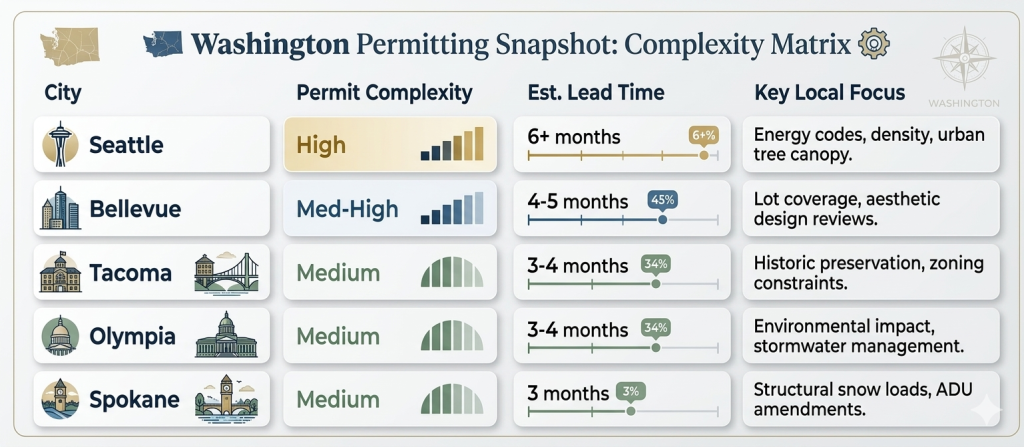
Currently, in Seattle, the massive volume of permit applications creates significant wait times. Specifically, you must navigate the Seattle Department of Construction & Inspections (SDCI), which mandates rigorous energy-efficiency requirements. Conversely, Bellevue’s municipal codes protect residential character; consequently, the city often requires neighborhood design reviews that do not exist in urban centers. Above all, you should verify if your project qualifies for a Seattle ‘Simple Permit’ before you initiate the full review process.
Tacoma vs. Olympia: Historic and Environmental Washington Municipal Building Codes
Tacoma presents a unique challenge: the “grandfathering” of older homes. When you renovate, you must ensure your plans align with Tacoma’s Historic Preservation Office standards. Meanwhile, Olympia’s codes operate differently; rather, they prioritize Washington State Department of Ecology guidelines, which makes environmental drainage and stormwater management a top priority. In addition, you should conduct site surveys early to avoid environmental delays.
Spokane vs. Spokane Valley: Climate and Zoning Washington Municipal Building Codes
Furthermore, in Spokane, construction demands more than just basic zoning adherence; instead, it requires a deep understanding of structural physics. Building codes here account for significant snow loads; likewise, structural roof inspections remain non-negotiable. Equally important, Spokane Valley features specific zoning amendments for Accessory Dwelling Units (ADUs) that offer more flexibility than those in the dense urban core of Spokane.
Applying Building Codes via The Contindex Roadmap
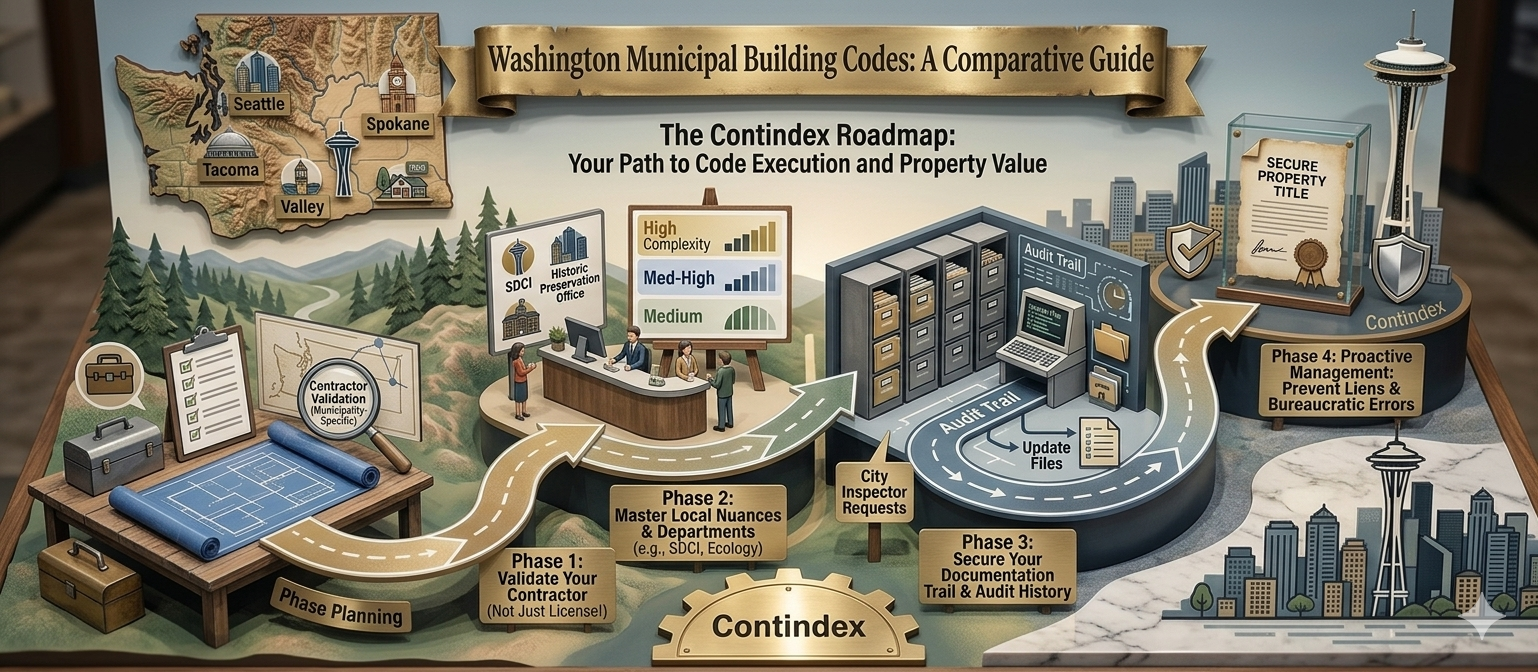
Knowing your local code represents only phase two of the Contindex Project Roadmap.
In reality, the code provides the legal framework; however, you determine the quality of your home’s value through your execution of that framework. To prevent common mistakes associated with municipal permitting, you should follow our protocols:
- Phase 1 (Planning): You must validate your contractor’s experience with Washington municipal building codes, not only their license. For instance, verify past work in your specific municipality.
- Phase 3 (Documentation): In the event that a city inspector requests changes, you must update all records in your Documentation Trail. As a result, you maintain a clean audit history.
- Phase 4 (Asset Protection): Finally, you must file all permitted work to prevent future Construction Liens. Thus, you secure your property title against legal exposure.
Ultimately, proactive management beats reactive troubleshooting. By integrating these findings into your project, you safeguard your investment against bureaucratic errors. Thus, you maintain complete control over your property, your budget, and your project’s final outcome.