

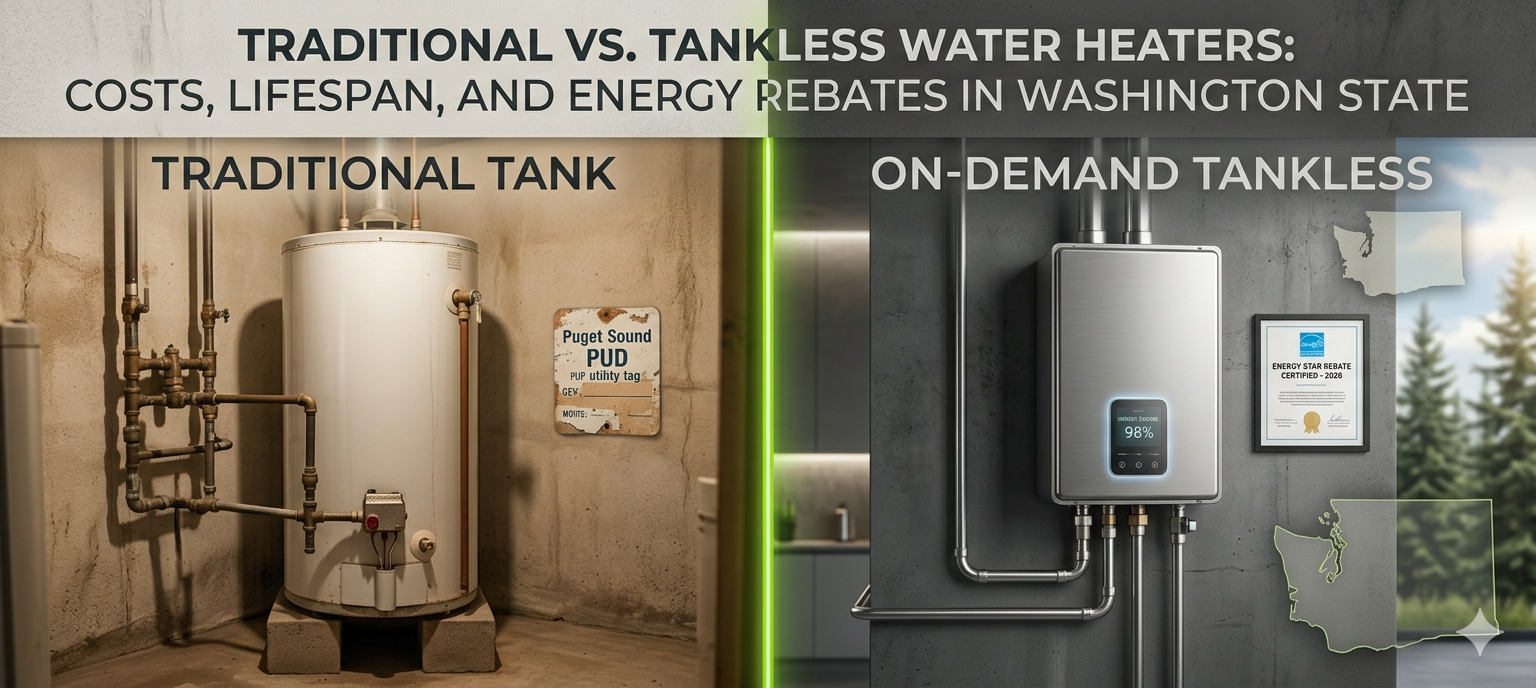
Homeowners make a strategic financial decision when they upgrade a residential water heating system. In the modern landscape of Washington’s real estate, this choice is no longer a simple matter of replacing a failed unit. As energy codes become more adventurous and utility costs fluctuate constantly, homeowners must act with precision. Therefore, understanding the nuances of Tankless Heaters in Washington is essential. You must optimize your home investment to maximize your long-term Return on Investment (ROI).
Why Install Tankless Heaters in Washington Today
First, Washington law requires licensed contractors to follow strict safety standards for a reason. Modern plumbing systems are complex networks that rely on balanced pressure. Traditional water heaters have served as the industry standard for decades. These storage tank systems operate on a simple but inefficient principle. They heat a large volume of water and maintain that high temperature 24/7. This method results in “standby heat loss.” Your system wastes energy by keeping water hot even when the house is empty. Experts call this an inefficient use of resources in a modern economy. Most families pay for heat they never actually use.
In contrast, Tankless Heaters in Washington utilize high-powered burners or electric coils to heat water instantaneously. These “on-demand” heaters activate only when you turn on a faucet. This fundamental difference in operation drives the energy efficiency that defines the modern Pacific Northwest home. When you consider this technology, you must first evaluate your current infrastructure. Often, this transition requires a broader look at systemic upgrades. For a detailed breakdown of associated costs, read our Residential Pipe Replacement Cost in WA: 2026 Price Guide.
Costs and Lifespan of Tankless Heaters in Washington
A primary barrier often stops the adoption of new technology. This barrier is the initial capital expenditure. In Washington, a professional installation of a high-efficiency unit costs between $3,500 and $6,000. This price depends on gas line requirements and venting complexity. A traditional tank system typically costs between $1,500 and $2,800. The price gap seems large at first glance.
However, a sophisticated ROI analysis reveals a different story. Consequently, two main factors mitigate the higher upfront cost of Tankless Heaters in Washington. These factors are operational efficiency and unit longevity. These units can be up to 34% more energy-efficient than traditional tanks. This applies specifically to homes that use moderate amounts of hot water daily. Over the 20-year expected lifespan of a tankless system, the cumulative energy savings often exceed the initial price gap. Furthermore, these units reclaim valuable physical footprint. In urban markets like Seattle or Bellevue, square footage remains a high-value commodity for any property owner.
The local water chemistry also heavily influences the lifecycle of plumbing appliances. In the Pacific Northwest, usage patterns play a critical role in equipment health. A traditional tank system usually reaches its “end-of-life” stage between 10 and 12 years. The primary failure point is the tank itself. It eventually succumbs to corrosion despite your best maintenance efforts. A leaking tank often causes secondary water damage to floors and walls. On the other hand, manufacturers engineer Tankless Heaters in Washington for extreme durability. Most units boast a service life of 20 years or more.
Energy Rebates and Fiscal Incentives in Washington
One of the most compelling arguments for upgrading technology involves fiscal incentives. Washington State leads the nation in promoting high-efficiency appliances. The state achieves this through utility-sponsored rebates and federal tax credits. You can significantly lower your effective cost by applying for these programs early in the process.
Organizations such as Puget Sound Energy (PSE) and Snohomish PUD frequently offer significant rebates. These incentives range from $200 to $1,000 for qualifying units. You must choose Tier 3 or Tier 4 systems to qualify for the maximum amount. Moreover, federal credits under the Inflation Reduction Act can cover up to 30% of the installation cost. These credits have specific annual limits that you should track. For a comprehensive database of these opportunities, consult the Database of State Incentives for Renewables & Efficiency (DSIRE) – Washington.
Infrastructure Compatibility and Professional Licensing Requirements
You cannot treat Tankless Heaters in Washington as a “plug-and-play” operation. These units require specific gas pressure levels to function correctly. They also need specialized venting to handle high-temperature exhaust safely. Often, you will need electrical circuit upgrades to support the ignition system or electric coils. Indeed, the complexity of these installations makes hiring a professional a legal and safety requirement in every county.
In Washington, the distinction between license levels remains critical for this task. An installer must understand the intersection of plumbing codes and gas requirements. You must ensure your contractor has the appropriate credentials for this high-tech installation. Review our guide on Journey Level vs. Specialty Plumbers for more details. Using a specialty plumber for a gas line expansion ensures your warranty remains valid. A journey-level professional handles the system integration to keep your home compliant with local codes. Never skip the permit process for these high-pressure systems.
Environmental Impact and the PNW Climate Challenges
The Pacific Northwest climate presents unique challenges for residential water heating. Cold groundwater temperatures in winter mean that a heater must work harder. The unit needs more energy to reach a comfortable “set point” for your morning shower. High BTU (British Thermal Unit) systems handle this “temperature rise” perfectly. They do this without sacrificing your flow rate or water pressure.
Homeowners who choose Tankless Heaters in Washington reduce their carbon emissions significantly. You also eliminate the waste associated with discarding massive steel tanks every decade. This shift toward electrification and high-efficiency gas usage is not just a trend. It represents the future of Washington’s residential infrastructure. We see this transition as a responsible choice for the eco-conscious homeowner. A greener home often fetches a higher price in the competitive WA real estate market.
Maintenance Protocols for Peak Performance
You must maintain your system to reach that 20-year lifespan goal. Washington homeowners often deal with mineral buildup in their heat exchangers. We recommend a professional descaling service once a year. This process involves flushing a cleaning solution through the unit to remove calcium deposits. If you ignore this, the efficiency drops and the heating elements might overheat.
Furthermore, you should check the air intake and exhaust vents regularly. Birds or debris can sometimes block these paths during the stormy PNW months. A clear vent ensures the system burns fuel efficiently and safely. It also prevents the unit from shutting down due to safety sensors. Modern units often display error codes to help you diagnose these issues quickly. If you follow these simple steps, your system will provide endless hot water while maintaining its high ROI.
The ROI of Tankless Heaters in Washington State
The state continues to push for “greener” building standards every single year. Future regulations might make traditional tanks obsolete in new constructions very soon. By installing Tankless Heaters in Washington now, you stay ahead of the curve. You also make your home more attractive to future buyers who value energy efficiency and low utility bills.
Contindex recommends evaluating your hot water needs today. Do you have a large family that needs back-to-back showers? This technology eliminates the “waiting period” between users. You never have to worry about the last person getting a cold shower. This lifestyle benefit, combined with the financial savings, makes the technology a superior choice for the modern Washington household. Proper planning today ensures comfort for the next two decades.
Space Optimization and Architectural Freedom
Modern homes in Washington are becoming more compact and efficient. A traditional water heater occupies a significant amount of floor space in a garage or basement. Usually, you lose about 12 to 15 square feet of usable area. For many, this space could serve as additional storage or even a small workstation. Wall-mounted units change this dynamic entirely.
Additionally, you can install these units in places where a traditional tank would never fit. Some homeowners choose to install them in laundry rooms or even outdoor-rated enclosures. This flexibility allows architects to design more creative floor plans. When you reclaim this space, you effectively increase the utility of your home. In cities like Seattle, where every square foot counts, this is a major selling point. Consider the “hidden” value of space when you calculate your final ROI.
Final Financial Synthesis: Is the Switch Truly Worth It?
Data points toward a clear conclusion for long-term residents when we synthesize costs and rebates. If you plan to remain in your home for more than seven years, the ROI of Tankless Heaters in Washington is indisputable. The combination of lower monthly utility bills and reduced maintenance frequency creates a strong financial case. You also benefit from the immediate infusion of rebate cash from local utilities.
In conclusion, the strategic benefits outweigh the higher initial investment. These systems offer space savings and increased home resale value. You secure a modern, efficient, and reliable hot water solution for decades. Leverage local incentives and ensure professional installation through certified plumbers to finalize your home’s upgrade. Your future self will thank you for the foresight and the savings.